MAELSTRÖM LIFE (2010-2026)
Archeology¬EDUCATION¬TECHNOLOGY¬Episteme
[][][][][]
[][][][]
ABOUT THE MAELSTRÖM
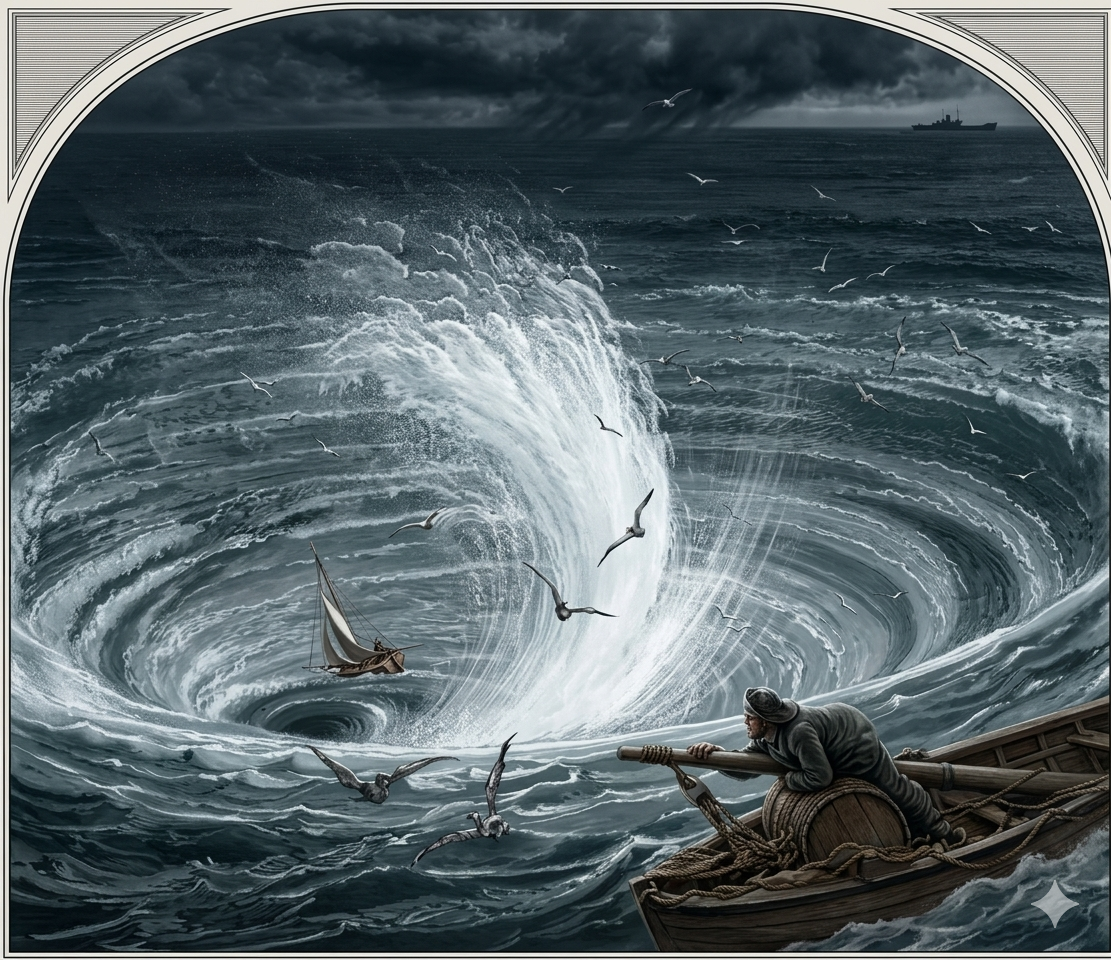
In the Dutch language, the noun maelström derives from malen (to grind, whirl) and stroom (current), designating the formation of vast maritime whirlpools recurrent in the North Atlantic, especially along the liminal zones between the Atlantic and the Arctic Oceans. In 1841, Edgar Allan Poe published A Descent into the Maelström, in which the phenomenon assumes the form of a parable.
Three fisherman brothers regularly fish in the vicinity of a maelström off the Norwegian coast, drawn by the abundance of fish surrounding the vortex. During a storm, they are suddenly overtaken by the abrupt formation of a gigantic marine whirlpool. The youngest brother vanishes in the initial chaos, while the remaining two are seized by the force of the phenomenon. Faced with the terrifying spectacle of the maelström, the eldest brother progressively succumbs to panic and disorientation, ultimately being dragged toward the center of the abyss.
The middle brother – the narrator of the story – initially experiences the same terror; yet rather than remaining paralyzed, he begins to observe attentively the behavior of the vortex itself. Amid the chaos, he realizes that cylindrical bodies resist the suction of the whirlpool longer than other forms. From this observation, he abandons the wreckage of the vessel and fastens himself to a barrel floating nearby.
His survival results neither from physical strength nor from chance, but from the capacity to interpret the very movement of chaos. When the maelström finally loses intensity, the narrator returns to solid ground transformed by the experience – as someone who has passed through an extreme disruption and extracted from it a form of knowledge.
MAELSTRÖM AS AN IMAGE OF THE CONTEMPORARY
Marshall McLuhan reads the maelström as an image of the technical and perceptual mutations of culture. In The Gutenberg Galaxy (1962), he formulates the question: “Is it not our task in the new electronic age to study the action of the new vortex upon the body of older cultures?”. Marcelo Gleiser, in Descent into a Cosmic Maelström (2001), rethinks the image within astrophysics, bringing it closer to the phenomenon of black holes, where space bends under extreme gravitational intensities. Norbert Elias, in Involvement and Alienation (1987), reinscribes the maelström within the horizon of the Cold War and the nuclear threat as a regime of civilizational turbulence. Bruno Latour, in Down to Earth (2018), reconfigures it as a figure of the “new climatic regime,” in which the Earth ceases to operate as a stable background for human action.
HEURISTIC IMAGE AND EPISTEMOLOGICAL DISPOSITION
In my academic research trajectory, the “descent into the maelström” has progressively come to function as a heuristic image for addressing contemporary anthropotechnical processes. An analogous gesture can be observed in the artistic project of Aurélien Gamboni and Sandrine Teixido, in which the maelström is worked as a conceptual operator and aesthetic device in A Tale as a Tool. Beyond an illustrative metaphor, the maelström operates as a perspective of inquiry into contemporary sociotechnical milieus, marked by acceleration, crisis, and the continuous reorganization of the conditions of experience. It was from this perspective that, in 2010, I named this site Maelström Life, conceived as a space for the elaboration of a philosophical horizon guiding my academic work, especially in the field of education.
SIGNIFICANT INFLUENCES
Since then, two authors have become particularly decisive as theoretical devices. Harun Farocki, who, faced with “images of the world” and from the editing table, brought forth a transindividual dimension of the image. His work allows for a critical archaeology of the dispositifs of visibility, education, and labor, calling for sustained attention to the ways in which the world is produced and inscribed within historical regimes of visibility. Bernard Stiegler, who developed a pharmacological “toolbox” aimed at the reconstruction of care of the self and of others as an ethical-pedagogical core. His analyses of techno-capitalist accelerations make visible processes of proletarianization and disindividuation operated by dispositifs of attention capture and the reorganization of collective psychic life.
INTELLECTUAL PROJECT
From this trajectory emerged my longest-standing project: Archaeology of Educational Epistemes. In this project, I investigate how the technê tou biou (arts of living) and their askêseis (spiritual exercises) became articulated with diverse hypomnemata (supports of memory) throughout Western history. The objective is to understand both the forms of knowledge that structured the past and those capable of grounding new politics of care in the present. The aim is to recover, within material culture, critical elements for rethinking education and collective life in the face of contemporary dynamics of acceleration and instability. Deceleration must be conceived as a condition of possibility for renewed processes of individuation, linked to practices of care and to more artisanal modes of psychic and collective individuation, especially within hyperindustrial environments.
NAVEGATION
BIO
ARTICLES
BOOKS
TEACHING
RESEARCH
***
Header image: digital adaptation and treatment of the illustration for Jules Verne's essay 'Edgar Poë et ses oeuvres' (Edgar Poe and His Works, 1862), drawn by Frédéric Théodore Lix (or by Yan' Dargent).
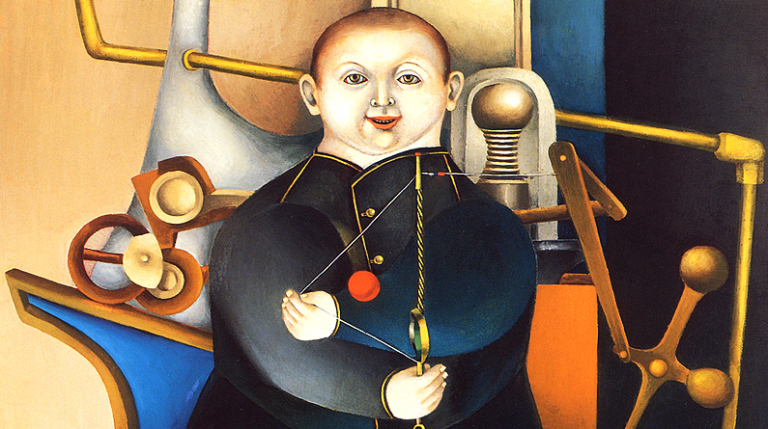
Image below: Richard Lindner, Boy with Machine (Menino com máquina, 1954) - detail. (In Anti-Oedipus, Deleuze and Guattari draw on this painting to illustrate the inseparability of human beings and machines, suggesting that desire operates through machinic assemblages rather than as the expression of an isolated interiority.